Wednesday, May 12, 2010

FT-817 resources online

There's a wealth of digested experience on this particular radio online.

ka7oei has a detailed site which has pages devoted to the following topics:

    Other FT-817 related sites include:
    One of G4ILO's 'Radio topics' pages is devoted to the FT-817. His document points to 817-Mem, a program to manage memories on the radio.

    WSPR

    Prompted by Julian G4ILO's musings about the possibility of volcanic ash being responsible for propagation he observed a few days back, I've been looking deeper into WSPR, the application that produced the data that inspired the notion.

    First stop was the main WSJT site where Princeton physicist Joe Taylor K1JT outlines the application along with other weak signal communications applications. The WSPR page points to the 20pp. User's Guide (pdf).

    There's also some information at the WSPRnet site - especially the stunning map and the detailed database of recent spots.


    Full circle  - when I searched for a general introduction to the software and the mode it's based on - sure enough I end up back with Julian, G4ILO. He's published a very readable and comprehensive article which quite rightly comes up #4 on a WSPR google search. He describes how easy it is to become part of a global beacon network and contribute to the generation of up-to-the-minute propagation reports.

    Right now, I'd really like to know how to interpret the colour and thickness of the lines tracing the transmission paths on the map. 

    It is, ah, not raining here also!

    Via vk3app's twitter feed, a pointer to the first part of the definitive and classic Hancock episode, 'The Radio Ham'.


    Painfully hilarious!
    Part 1  |  Part 2  |  Part 3

    Volcanic propagation

    G4ILO has some interesting observations and speculation about recent 10m openings in his part of the world. He wonders whether they might be scatter off the clouds of volcanic ash drifting to Europe from Iceland.

    Tuesday, May 11, 2010

    SDR lists

    Via M1KTA's blog a pointer to Christophe F4DAN's exhaustive list of SDR projects.

    What an amazing resource! It feels like the distillation of many hours of research and study.

    Really valuable information in here. It was last updated at the end of March. Also available in 'une version française'.

    Monday, May 10, 2010

    A123 batteries

    There's been a great explanation posted on the Buddipole list about the practicalities of using the A123 battery packs Buddipole sell from their site.


    The advantages of the A123 chemistry are low weight, fast charge times and ability to deliver high current. As well their voltage - 13.2v for a four cell pack such as the one shown - is well-suited to modern amateur radio gear.  

    The email exchange is yet another example of how an innocent newbie's question can draw out the best information which benefits the broader group. Mark KD5RXT's explanation of duty cycle and the unique qualities of this new battery chemistry are almost text-book ready!


    I'm still keen to find out more about the selection of the best solar cell and charger system to keep such a battery topped up. I sense that a system that could take advantage of its fast charge rate might dwarf the rest of the radio gear. And I also sense that current portable solar panels, especially the expensive roll-up ones might barely keep track even at QRPp levels.

    iPad date announced for Australia

    News this morning from Apple that the delivery date for iPad (both WiFi & 3G) - in Australia - is 29th May.

    I'm so looking forward to seeing how an iPad might fit into a portable QRP operation. Or even a remote one. I'm also hoping that Apple will retain enough of open protocols so that the device does not simply become an expensive personal front end to whatever shops they wish to set up, like the sadly not ready for primetime Kindle.

    Lack of a camera on the iPad is odd - given the next iPhone will actually have two - one in the front as well as the existing one on the back. Bluetooth keyboard sounds like it could be fun. I also imagine that ham radio apps to track satellites (ProSat) and monitor solar activity (Space Wx, 3D Sun etc) should look amazing. A work colleague showed me his new Android phone with a graphically brilliant astronomy application that you could use to locate, stars, planets and constellations easily. It felt like visual velvet and the images were much richer than I've seen so far on the iPhone.

    Even a straighforward app to display bandplans should be able to be made to look clear and brilliant and enable you to get different views depending on mode, QTH or licence class.

    Friday, May 7, 2010

    The creator of the Continental code

    I stumbled on to a page on Wikipedia about Friedrich Clemens Gerke, (22 Jan 1801 - 21 May 1888) the man responsible for simplifying Vail and Morse's original telegraphic code.

    As the wikipedia article explains, "The original Morse code consisted of four different hold durations (the amount of time the key was held down), and some letters contained inconsistent internal durations of silence. In Gerke's system there are only "dits" and "dahs", the latter being three times as long as the former, and the internal silence intervals are always a single dit-time each."

     This chart reveals the logic behind his reform of the code.


    After some minor changes it was standardised at the International Telegraphy congress in Paris in 1865.

    Thursday, May 6, 2010

    Fabric antenna

    Via Southgate News and MAKE magazine news of a collapsible fabric yagi antenna developed by Diana Eng KC2UHB who has combined two craft skills in a stylish way, electronics and sewing. It's a design for a Yagi for portable amateur radio satellite operation.
    Her MAKE magazine article is well-written, comprehensive and brilliantly illustrated.
    Diana Eng has also written an earlier article aimed at newcomers to amateur satellites for MAKE that covers:
    • Finding out when to listen
    • Finding the frequency
    • Aiming a whip antenna
    • Following the pass with the antenna
    • Tuning the radio for the Doppler effect
    Check the size of the antenna in that earlier piece and you'll understand why she aimed at something more portable!

      Wednesday, May 5, 2010

      KGD antenna translation

      I'm keen to have a go at building a 40m version of the KGD short vertical dipole that used to be sold by QRPprojects.

      Step one will be to translate whatever information I can find. It's happening here.

      Tuesday, May 4, 2010

      Silicon Chip (May 2010) and Elektor (March 2010)

      Picked up two new (for me) electronics magazines.


      Highlights of the Silicon Chip:
      • Solar-powered lighting controller - a detailed description of the issues involved in the design. I've always been a fan of the Radio & Hobbies etc house style of technical writing. I grew up on in fact so it's like mother's milk to me. 
      • There's also a very neat and compact 12v Stereo Amplifier that seems to be designed for buskers with SLA batteries. How many banjo players have you seen who need a PA? How many buskers play the banjo? I think there's a joke waiting to pop out there.


      Highlights of the Elektor issue:
      • Sceptre, a 32-bit ARM7 fast prototyping system. Open source, open hardware and open mobile. The project is a response to the low calculating power of the Arduino. This looks like a good way to dive head first into microcontrollers.
      • An interesting article on the carbon footprint and appliances, standby power, manufacture and distribution and of course in generating the power to run the appliances.

      Monday, May 3, 2010

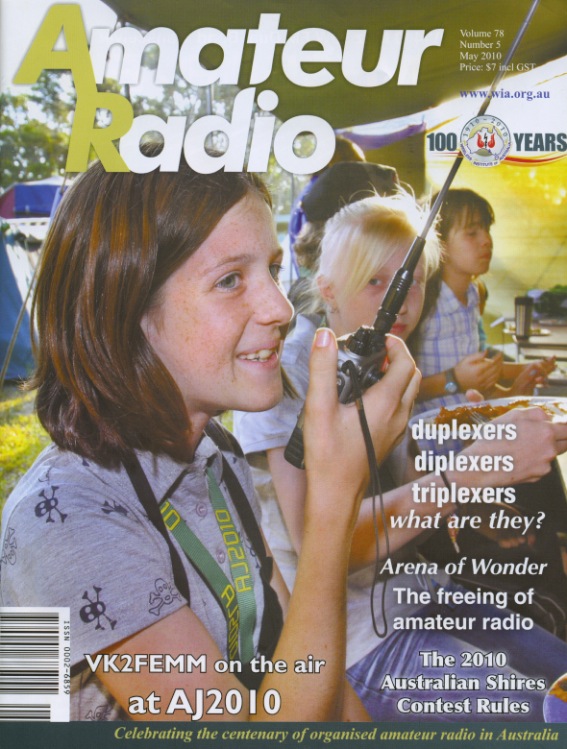
      Latest 'Amateur Radio' arrived


      Received the latest 'Amateur Radio' magazine for May today. I really like the new look and the magazine feels like it's really arrived. It's always been a good read, but now the layout is matching the quality of the information. It's much easier on the eye and there also seems to be more investment in selecting the right mix of content.

      Anyway, this month's highlights include :
      • a continuation of the brilliant historical articles AR has been running as part of the Wireless Institute of Australia's centenary celebrations
      • good technical articles about duplexers, diplexers and triplexers, quad loop antennas, homebrew butterfly capacitors and how to make your own ladder line using lego blocks!

      I always think it's a healthy sign when you get more inspiration and enjoyment out of the content than the advertisements! And I suppose you don't one without the other.

      Sunday, May 2, 2010

      Morse gems

      Browsing today and came across some rich veins of morse information, including a great list of morse related links on the SKCC site, G0RDO's Morsemad site which has another fantastic list and the site of George VK2DLF with his brilliant keys such as the model 900 below.


      These keys look like they're worth the 6-12 month wait.

      Portuguese in morse

      This page has a listing of how different alphabets and accented characters are sent with morse including Russian, Greek, Hebrew, Arabic, Japanese and Korean. I feel an overwhelming urge to change it from its dots and dashes layout to a didah format to reinforce the sound and not the visual structure of the characters. As comprehensive as these charts are, I'm still a little in the dark about some accents used in Portuguese. It could be that they're simply not used in morse. Maybe listening to QSOs is the only way to confirm this.

      Even the listing on the Portuguese Wikipedia page is missing the ã character. And this Brazilian page makes no mention of accented characters, even though it does explain that the codes for each character reflect their frequency in English.

      Saturday, May 1, 2010

      Palm Paddle and Code Cube

      Took delivery yesterday of a Palm Radio Paddle and the Code Cube. Reassuring how well made they are. The paddle is very finely adjustable. t comes with a neat base which has two strong magnets which have s great grip on the top of a FT-817 and make for a very compact package.


      Very convenient combo for practising using a paddle and ready to go out of the box - but I can't work out how to adjust the actual volume of the sidetone. Maybe it can't be done. Excellent quality is such a relief when you buy something sight unseen on the recommendations of others.

      I also got the Peg Legs for the FT-817 which are very neat and retractable. They took all of a couple of minutes to attach to the tiny transceiver. It took me longer to work out how to re-thread the carrying strap through the bracket slots. Good to put the brain through its paces.